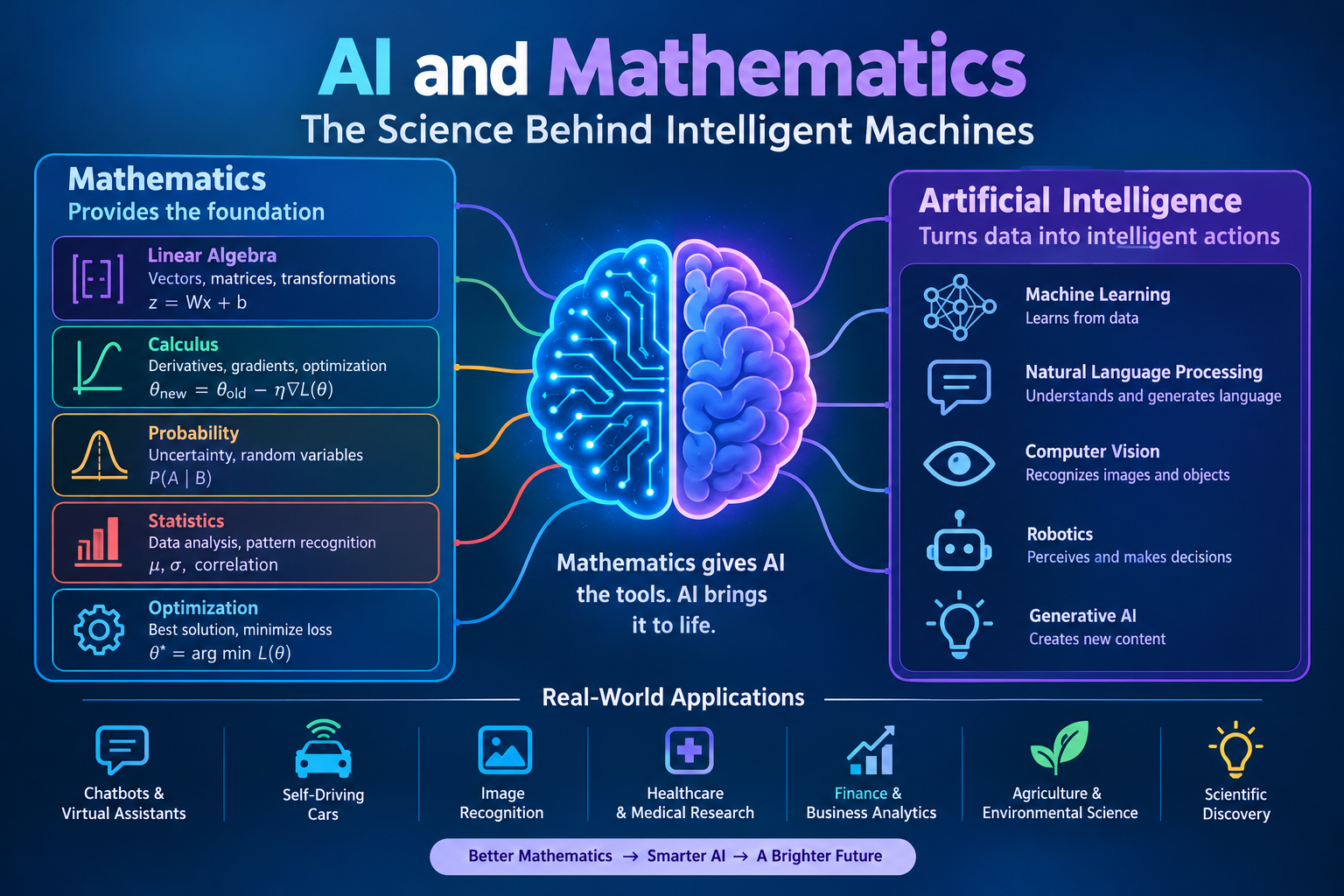
Artificial Intelligence (AI) and Mathematics are closely connected. Mathematics provides the foundation that allows AI systems to learn from data, recognize patterns, make predictions, solve problems, and improve their performance. From chatbots and image recognition to self-driving cars and scientific research, mathematical concepts are essential to the development of modern AI technologies.
Although AI may appear to be an independent technological field, many of its most important techniques are built on mathematical principles. Linear algebra helps computers process large amounts of data, calculus enables neural networks to learn, probability helps AI deal with uncertainty, and statistics allows machine learning models to identify meaningful patterns.
Understanding the relationship between mathematics and artificial intelligence is therefore important for students, programmers, researchers, and anyone interested in machine learning, data science, or the future of technology.
1. What Is the Relationship Between AI and Mathematics?
Artificial intelligence is a branch of computer science that focuses on creating systems capable of performing tasks that normally require human intelligence. These tasks include understanding language, recognizing images, making decisions, and solving complex problems.
Mathematics provides the tools and methods used to develop these intelligent systems.
For example, imagine an AI system designed to predict house prices. The system receives information about house sizes, locations, numbers of rooms, and historical selling prices. It uses mathematical models to identify relationships between these variables and estimate the price of a new house.
Similarly, an AI chatbot processes numerical representations of words and learns statistical patterns in language to generate responses.
In both cases, mathematics transforms raw information into something a computer can analyze and use to make predictions.
The relationship can be summarized as follows:
Mathematics provides equations, models, and optimization techniques.
Computer science provides algorithms, programming languages, and computational systems.
Data provides examples from which AI models can learn.
Artificial intelligence combines these elements to perform intelligent tasks.
Mathematics is not the only foundation of AI, but it is one of its most important foundations.
2. Linear Algebra: The Language of AI Data
Linear algebra is one of the most important areas of mathematics in artificial intelligence. It deals with vectors, matrices, and operations involving multidimensional data.
AI systems frequently represent information as numerical values. A photograph, for example, can be represented as a collection of pixel values, while a sentence can be represented using numerical vectors.
Linear algebra makes it possible to process these representations efficiently.
How vectors and matrices work in AI
A vector is an ordered collection of numbers. For example:
[
x = [2,4,6]
]
A matrix is a rectangular arrangement of numbers:
[
A =
\begin{bmatrix}
1 & 2\
3 & 4
\end{bmatrix}
]
In machine learning, vectors may represent features of an object, while matrices may contain datasets, model parameters, or transformations applied to information.
A basic neural network calculation can be written as:
[
z = Wx+b
]
Here:
(x) represents the input data.
(W) represents the weights learned by the model.
(b) represents the bias.
(z) represents the resulting values before an activation function is applied.
This operation is repeated across many neurons and layers in a neural network.
Why it matters: Linear algebra allows AI systems to perform millions or billions of numerical operations efficiently. It is especially important in deep learning, computer vision, natural language processing, and large language models.
3. Calculus: How AI Models Learn
Calculus is another fundamental part of artificial intelligence. It helps explain how small changes in a model's parameters affect its predictions.
During training, an AI model makes predictions and compares them with the correct answers. The difference is measured using a loss function.
For example, if a model predicts a house price of $180,000 when the actual price is $200,000, its prediction has an error. Training attempts to reduce such errors.
Calculus helps determine how the model's parameters should change to reduce the loss.
Understanding derivatives and gradients
A derivative measures how a function changes when its input changes. In machine learning, derivatives help estimate how changing a model parameter affects its error.
A common optimization method is gradient descent:
[
\theta_{\text{new}} =
\theta_{\text{old}}-\eta\nabla_\theta L(\theta)
]
Where:
(\theta) represents the model's parameters.
(L(\theta)) represents the loss function.
(\nabla_\theta L(\theta)) is the gradient of the loss.
(\eta) is the learning rate.
The gradient indicates the direction in which the loss increases most rapidly. Subtracting a suitably scaled gradient moves the parameters toward a lower-loss value.
Neural networks commonly use backpropagation to calculate gradients efficiently. An optimizer then uses these gradients to update the model's parameters.
It is important to understand that gradient descent does not guarantee finding the globally best solution in every problem. Its effectiveness depends on the model, the loss function, the data, and the optimization settings.
Why it matters: Calculus is essential for understanding neural network training, model optimization, and many deep learning algorithms.
4. Probability: Helping AI Handle Uncertainty
Real-world information is often incomplete, ambiguous, or uncertain. Probability provides a mathematical framework for reasoning about uncertainty.
Consider an email classification system that must decide whether a message is spam. It may analyze the words, links, sender information, and other features of the message to estimate the likelihood that it is spam.
Instead of relying only on fixed rules, a probabilistic model can estimate:
[
P(\text{Spam}\mid\text{Email features})
]
This expression represents the probability that an email is spam given its observed features.
Probability is also important in speech recognition, medical image analysis, forecasting, recommendation systems, and language models.
For example, a language model may assign probabilities to different possible next tokens based on the preceding context. These probabilities help determine which tokens can be generated.
However, a high probability does not necessarily mean a prediction is correct, and a probabilistic output should not automatically be treated as a reliable measure of real-world certainty.
Why it matters: Probability helps AI systems model uncertainty, compare possible outcomes, and make informed predictions from incomplete information.
5. Statistics: Learning Patterns From Data
Statistics focuses on collecting, analyzing, interpreting, and drawing conclusions from data. It plays a central role in machine learning because AI models are often trained using examples rather than manually written rules for every possible situation.
Suppose a student wants to build an AI system that predicts examination results. The system might use historical data about study hours, attendance, previous marks, and examination performance.
Statistical methods can help identify relationships between these variables and determine whether the observed patterns are meaningful.
Statistics also supports several essential machine learning activities:
Data analysis: Understanding distributions, averages, correlations, and outliers.
Model evaluation: Measuring how accurately a model performs on unseen examples.
Sampling: Selecting representative subsets of data.
Hypothesis testing: Evaluating certain claims about data when the relevant assumptions are satisfied.
Uncertainty estimation: Understanding how much confidence to place in a result.
A particularly important concept is the distinction between correlation and causation. Two variables may change together without one directly causing the other.
AI systems can learn misleading patterns when datasets are biased, incomplete, or poorly collected. Statistical thinking helps researchers detect these problems and evaluate models more carefully.
Why it matters: Statistics connects mathematical theory with real-world data and helps determine whether an AI system has learned useful patterns or merely memorized its training examples.
6. Optimization: Finding Better AI Models
Optimization is the mathematical process of finding the best available solution according to a particular objective.
In machine learning, the objective is often to minimize a loss function that measures prediction errors.
For example, a model trained to recognize handwritten digits may initially classify some images incorrectly. During training, an optimization algorithm adjusts the model's parameters to reduce the loss across the training data.
A simplified objective is:
[
\theta^*=\arg\min_\theta L(\theta)
]
This means finding the parameter values (\theta^*) that minimize the loss function (L), subject to the model and its constraints.
Optimization is used in:
Training deep neural networks.
Selecting model parameters.
Improving recommendation systems.
Scheduling and resource allocation.
Robotics and motion planning.
Developing efficient machine learning systems.
Optimization is closely connected to calculus, linear algebra, and numerical methods. In practice, researchers must also consider computational cost, overfitting, and performance on data the model has not seen before.
7. How Mathematics Powers Neural Networks
Neural networks are machine learning models inspired loosely by the interconnected structure of biological nervous systems. Artificial neurons receive numerical inputs, apply mathematical transformations, and pass results to other neurons.
A simplified artificial neuron can be described as:
[
a=f(w_1x_1+w_2x_2+\cdots+w_nx_n+b)
]
Where:
(x_1,\ldots,x_n) are input values.
(w_1,\ldots,w_n) are learned weights.
(b) is a bias term.
(f) is an activation function.
(a) is the neuron's output.
The weights determine how strongly different inputs influence the result. During training, the network adjusts these weights to improve its predictions.
A neural network combines several mathematical ideas:
Linear algebra calculates weighted sums and transforms data.
Nonlinear functions allow the network to learn complex relationships.
Calculus calculates gradients during training.
Optimization algorithms update the parameters.
Statistics supports evaluation and generalization to new data.
When many layers are connected, the result is a deep neural network. Deep learning uses these networks to solve complex problems involving images, text, sound, and other forms of data.
8. The Role of Mathematics in Generative AI and Large Language Models
Generative AI systems can create text, images, audio, and other content. Large language models, including modern AI chatbots, rely on mathematical methods throughout their development.
One important concept is the transformer architecture, which uses attention mechanisms to process relationships between elements in a sequence.
For example, when a language model processes a sentence, attention helps it determine which other words or tokens are relevant to the current representation.
A simplified attention equation is:
\operatorname{softmax}
\left(
\frac{QK^\top}{\sqrt{d_k}}
\right)V
]
Here:
(Q) represents queries.
(K) represents keys.
(V) represents values.
(d_k) is the dimension of the key vectors.
The equation uses matrix multiplication, scaling, and the softmax function to calculate attention weights and combine information.
Large language models also depend on probability to predict tokens, calculus and optimization to learn parameters, and statistical methods to evaluate performance.
These systems contain enormous numbers of learned parameters, so efficient numerical computation is crucial.
Nevertheless, mathematical complexity does not guarantee that an AI model will always produce correct, fair, or reliable answers. Model quality also depends on training data, architecture, evaluation, and how the system is used.
9. Which Mathematical Subjects Should You Learn for AI?
You do not need to master every area of mathematics before beginning artificial intelligence. However, building a strong foundation makes it easier to understand how machine learning algorithms work.
Mathematical subjectMain conceptsApplication in AIAlgebraEquations, variables, functionsUnderstanding formulas and model relationshipsLinear algebraVectors, matrices, matrix multiplicationNeural networks and data representationsCalculusDerivatives, gradients, chain ruleBackpropagation and model trainingProbabilityRandom variables, conditional probabilityPrediction and uncertaintyStatisticsDistributions, sampling, estimationData analysis and model evaluationOptimizationLoss functions, gradient descentImproving model performanceDiscrete mathematicsLogic, sets, graphs, combinatoricsAlgorithms, search, and graph-based AIFor beginners, algebra and functions are a useful starting point. Once these concepts are comfortable, linear algebra, probability, and basic statistics provide an excellent foundation. Calculus and optimization become especially important when studying neural networks in greater depth.
10. How to Start Learning Mathematics for AI
A practical learning plan combines mathematical concepts with small programming projects. Instead of studying equations in isolation, use Python to experiment with them.
Step 1: Strengthen your algebra
Learn variables, equations, functions, exponents, logarithms, and graphs. These concepts appear throughout machine learning.
Step 2: Study linear algebra
Practice vectors, matrices, dot products, matrix multiplication, and basic vector geometry. Use Python and NumPy to perform calculations.
Step 3: Learn probability and statistics
Study mean, variance, probability distributions, conditional probability, correlation, and sampling. Analyze small datasets to see how the concepts work in practice.
Step 4: Learn calculus fundamentals
Understand derivatives, partial derivatives, gradients, and the chain rule. These topics help explain how neural networks learn.
Step 5: Learn Python and machine learning
Use libraries such as NumPy, pandas, and scikit-learn to build simple models. Start with linear regression, classification, and basic evaluation techniques.
Step 6: Explore neural networks
Once you understand the basics, study activation functions, loss functions, backpropagation, gradient descent, and eventually transformer architectures.
A useful beginner project is to build a model that predicts house prices from a small dataset. You can start with linear regression, examine how its parameters affect predictions, and measure the model's errors.
This approach develops both programming skills and mathematical understanding.
11. Can You Learn AI Without Advanced Mathematics?
Yes. You can begin using AI tools and building simple machine learning projects without first mastering advanced mathematics.
Many programming libraries provide ready-made algorithms that allow beginners to train models with relatively little code. You can learn how to prepare data, train models, evaluate predictions, and deploy applications while gradually improving your mathematical knowledge.
However, the mathematics becomes increasingly important when you want to understand why an algorithm works, troubleshoot difficult training problems, develop new architectures, or conduct AI research.
For example, using a neural network library may require only a few lines of code. Understanding how backpropagation calculates gradients and how optimization changes the model's parameters requires a deeper mathematical foundation.
The best strategy is to learn mathematics alongside practical projects rather than waiting until you know everything.
12. Why the Relationship Between AI and Mathematics Matters for the Future
Artificial intelligence is being applied to scientific research, education, healthcare, agriculture, finance, engineering, and many other industries. Mathematics helps researchers develop these systems, measure their performance, and understand their limitations.
The relationship is particularly important in several emerging areas:
Scientific AI: Mathematical models help researchers analyze complex physical and biological systems.
Robotics: Linear algebra, geometry, calculus, and optimization support perception, movement, and control.
Data science: Statistics and probability help transform large datasets into useful insights.
Natural language processing: Linear algebra, probability, and optimization underpin many language technologies.
AI safety and reliability: Statistical evaluation, optimization, and formal methods can help investigate errors and system behavior.
As AI systems become more sophisticated, the ability to combine mathematics, programming, and critical thinking will remain valuable.
Students who develop these skills can pursue opportunities in machine learning engineering, data science, AI research, robotics, and related technical fields. Specific career requirements vary, and research-focused positions often demand more advanced mathematics than application-development roles.
Conclusion
The relationship between artificial intelligence and mathematics is fundamental to understanding how modern AI systems work. Linear algebra enables computers to represent and transform data, calculus supports learning through gradients, probability helps model uncertainty, statistics provides tools for analyzing data, and optimization helps models improve their performance.
These subjects work together in machine learning, deep neural networks, generative AI, and large language models.
For students and aspiring AI developers, mathematics should not be viewed as an obstacle. It is a toolkit that makes artificial intelligence easier to understand and develop.
Start with algebra, learn linear algebra and statistics, build a foundation in calculus, and apply these concepts through Python projects. With consistent practice, you can move from simply using AI tools to understanding the mathematical principles behind them.
Ultimately, mathematics provides much of the language through which artificial intelligence learns from data, identifies patterns, and solves complex problems.
Frequently Asked Questions (FAQs)
1. Why is mathematics important in artificial intelligence?
Mathematics provides the equations and algorithms used to process data, train machine learning models, calculate prediction errors, and optimize model performance.
2. Which branch of mathematics is most important for AI?
Linear algebra, calculus, probability, statistics, and optimization are among the most important areas. Their relative importance depends on the AI application.
3. Is calculus necessary for machine learning?
You can use many machine learning tools without advanced calculus. However, derivatives, gradients, and the chain rule are valuable for understanding how neural networks are trained.
4. How is linear algebra used in neural networks?
Neural networks use vectors and matrices to represent data, calculate weighted sums, transform information between layers, and perform attention operations.
5. What is the role of probability in AI?
Probability helps AI models estimate the likelihood of possible outcomes and represent uncertainty in tasks such as classification, prediction, and language generation.
6. Can I learn artificial intelligence if I am weak in mathematics?
Yes. Begin with basic algebra and Python, then gradually learn linear algebra, probability, statistics, and calculus while working on practical machine learning projects.
7. What should I learn first: mathematics or Python?
Learn both together. Basic algebra and Python are a good starting combination, followed by linear algebra, statistics, and machine learning fundamentals.
Recommended learning path
Algebra → Python fundamentals → Linear algebra → Probability and statistics → Calculus → Machine learning → Deep learning → Generative AI
Following this sequence can help you build a solid foundation for understanding the mathematics behind artificial intelligence.


Comments
No comments yet.
Log in to comment.