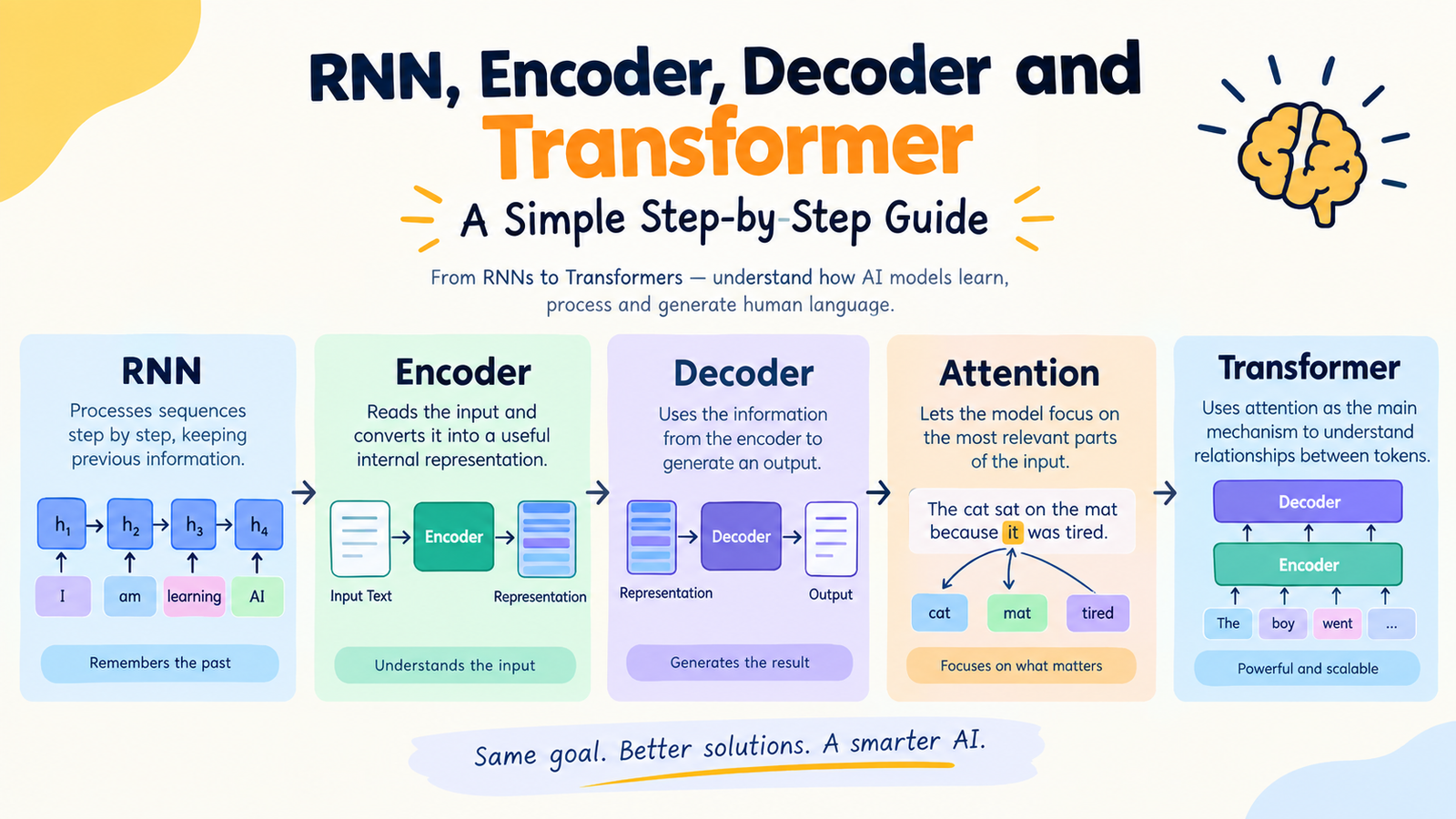
To understand modern AI, it is useful to learn about four important concepts:
RNN → Encoder → Decoder → Transformer
These technologies developed step by step, with each one solving some of the problems of the previous approach.
Let's understand them in simple language.
1. What is an RNN?
RNN stands for Recurrent Neural Network.
An RNN is a type of neural network designed to work with sequential data.
Sequential data is information where the order is important.
For example:
"I am learning AI."
The order of the words matters. If we change the order, the meaning may change.
How does an RNN work?
An RNN reads information step by step.
For example:
I → am → learning → AI
When the RNN reads "am", it can use information from "I".
When it reads "learning", it can use information from the previous words.
You can think of an RNN as having a small form of memory.
Simple example
Imagine that someone tells you:
"Ali went to the shop."
A few seconds later they ask:
"Where did Ali go?"
You remember the previous information and answer:
"The shop."
An RNN tries to maintain information from previous steps in a similar way.
The problem with RNNs
RNNs can have difficulty remembering information from very long sequences.
For example:
"The student who studied computer science for many years, completed several projects, participated in competitions, and worked on different AI systems finally..."
The important information may be many words away.
Traditional RNNs can struggle to maintain useful information over very long sequences.
This encouraged researchers to develop better architectures.
2. What is an Encoder?An encoder is a component that takes input and converts it into a useful internal representation.
Think of an encoder as a reader.
Suppose we give an encoder this sentence:
"I love artificial intelligence."
The encoder reads the sentence and processes its information.
The basic idea is:
Input → Encoder → Representation
The representation is a numerical form that the neural network can use to work with the information.
An encoder does not simply copy the input. It processes the input and creates information that can be useful for another part of the model.
3. What is a Decoder?A decoder is a component that uses processed information to produce an output.
Think of the decoder as a writer.
For example, imagine a language translation system.
We give it:
"I love artificial intelligence."
The encoder processes the English sentence.
Then the decoder generates the translated sentence.
The simplified process is:
English sentence → Encoder → Decoder → Translated sentence
The decoder may produce the output one word or token at a time.
For example:
"I" → "love" → "AI"
The decoder keeps generating until the complete output is produced.
4. Encoder and Decoder Working TogetherNow we can combine the two ideas.
Imagine that we want an AI system to translate English into French.
Step 1: Input
We provide:
"How are you?"
Step 2: Encoder
The encoder reads and processes the sentence.
Step 3: Internal representation
The information is passed to the decoder.
Step 4: Decoder
The decoder starts generating the French translation.
Step 5: Output
The system produces:
"Comment allez-vous ?"
So the basic architecture is:
Input → Encoder → Representation → Decoder → Output
This is called an Encoder–Decoder architecture.
It became very important for tasks such as machine translation and text generation.
5. The Problem With the Early Encoder–Decoder ApproachThere was still a problem.
Imagine an extremely long sentence:
"The student who studied computer science for many years, worked on several projects, participated in research, and learned different programming languages finally built an AI system."
The encoder has to process a large amount of information.
In early encoder–decoder systems, the encoder would try to compress the whole input sentence into a single internal representation.
This can be difficult.
Important information from the beginning of the sentence might become weaker or harder for the decoder to use when the sentence is very long.
It is a little like asking someone to read a whole book and then remember the entire book from just one short summary.
The longer the book, the harder it becomes.
Researchers needed a better solution.
That solution was called Attention.
6. What is Attention?Attention is a mechanism that allows the model to decide:
"Which parts of the input are important right now?"
Let's use a simple example:
"The dog chased the cat because it was fast."
Suppose the model is trying to understand the word "it".
It needs to look at the other words and determine what "it" refers to.
Attention allows the model to give more importance to relevant words.
Instead of trying to remember everything equally, the model can focus on the information that matters.
Simple idea
Without attention:
Input → One compressed representation → Decoder
With attention:
Input → Important parts can be accessed → Decoder
This was a major improvement.
7. Why Attention Was ImportantAttention solved an important problem with traditional encoder–decoder systems.
The decoder no longer had to depend only on one fixed representation of the entire input.
Instead, it could look at different parts of the input when generating each output token.
For example, when translating:
"The cat is sitting on the table."
The decoder can focus on different words when producing different parts of the translation.
So attention basically gives the model a way to say:
"For the word I am generating now, these parts of the input are more important."
This idea became one of the most important developments in modern AI.
8. From Attention to TransformersAttention was powerful, but researchers asked an important question:
What if we built an entire architecture around attention?
This led to the development of the Transformer.
In 2017, researchers introduced the Transformer architecture in the paper "Attention Is All You Need."
The Transformer changed the way neural networks processed language.
Instead of depending mainly on recurrence like RNNs, Transformers use attention as their main mechanism for understanding relationships between tokens.
9. What is a Transformer?A Transformer is a neural network architecture designed to process sequences, especially language, very effectively.
Its key idea is:
Use attention to understand relationships between different tokens.
Consider this sentence:
"The boy went to the store because he needed milk."
The model needs to understand that "he" refers to "the boy."
The two words are not next to each other.
A Transformer can use attention to connect them.
This allows the model to understand relationships between words even when those words are far apart.
10. Transformer EncoderA Transformer can contain an encoder.
The encoder's main job is to understand and represent the input.
The simplified process is:
Input text → Tokens → Encoder → Representations
For example:
"I love programming."
The sentence is first broken into tokens.
The Transformer encoder then processes those tokens and uses attention to understand their relationships.
The result is a set of rich numerical representations.
These representations contain information about the words and their context.
11. Transformer DecoderA Transformer can also contain a decoder.
The decoder's main job is to generate output.
For example, in a translation system:
English → Encoder → Decoder → French
Input:
"I love programming."
The encoder understands the input.
The decoder then generates the output, such as:
"J'aime programmer."
The decoder generates the output step by step.
For example:
Token 1 → Token 2 → Token 3 → Token 4
Each newly generated token helps the model decide what should come next.
12. Encoder–Decoder TransformersA Transformer can use both an encoder and a decoder.
This is called an Encoder–Decoder Transformer.
The process looks like this:
Input → Encoder → Understanding of the input → Decoder → Output
This architecture is useful for tasks where one sequence needs to be converted into another.
Examples include:
Language translation
Text summarization
Some question-answering tasks
Sequence-to-sequence tasks
For example:
13. Does Every Transformer Have an Encoder and Decoder?English sentence → Encoder → Decoder → French sentence
No.
This is an important point.
There are three common Transformer designs.
Encoder-only
An encoder-only model mainly focuses on understanding input.
For example, it can be used for:
Text classification
Sentiment analysis
Finding information
Creating text representations
A famous example is BERT.
Decoder-only
A decoder-only model mainly focuses on generating text.
This is the general architecture used by GPT-style large language models.
For example, if the input is:
"Artificial intelligence is"
The model predicts what comes next:
"changing"
Then it continues:
"Artificial intelligence is changing..."
It keeps predicting the next token until it produces the desired response.
Encoder–Decoder
This design uses both components.
The encoder understands the input, and the decoder generates the output.
It is especially useful for tasks such as translation and summarization.
14. RNN vs Encoder–Decoder vs TransformerNow let's connect everything together.
RNN
An RNN processes a sequence step by step while carrying information from previous steps.
Main idea:
Remember previous information while processing the next item.
Encoder–Decoder
The encoder processes the input, while the decoder generates the output.
Main idea:
One network understands the input, and another produces the output.
Attention
Attention allows the model to focus on the most relevant parts of the input.
Main idea:
Look at the information that matters most.
Transformer
The Transformer makes attention the central mechanism for processing relationships between tokens.
Main idea:
15. The Whole Story in Simple StepsUse attention to understand relationships efficiently.
The development can be remembered like this:
RNN → Processes sequences step by step.
Encoder–Decoder → Encoder understands the input and decoder generates the output.
Attention → Allows the model to focus on important parts of the input.
Transformer → Uses attention as the main mechanism for understanding relationships between tokens.
Modern Large Language Models → Use Transformer-based architectures to understand and generate text.
ConclusionRNNs, encoders, decoders, attention, and Transformers are not completely separate ideas. They are connected parts of the evolution of neural networks for language.
An RNN introduced a way to process sequential information while carrying information from previous steps.
The encoder–decoder architecture separated the job of understanding an input from the job of generating an output.
Attention improved this approach by allowing the model to focus on the most relevant parts of the input.
Finally, the Transformer made attention the central idea and allowed models to process relationships between tokens much more effectively.
Understanding this journey is important because it explains how we moved from relatively simple sequence models to the powerful Transformer-based AI systems used today.


Comments
No comments yet.
Log in to comment.